Five things to know about light pollution at night
Apr 17, 2023 10:02AM ● By Content Editor
Photo: Brad Mann via Unsplash.com
By Laura Durenberger-Grunow - Boreal Community Media - Updated April 17, 2025, Originally posted April 17, 2023
Cook County and Grand Portage residents are well aware of the magical beauty a clear night sky brings. Visitors to the area are often amazed by the vast number of stars and planets visible with the naked eye, and of course, the breathtaking sight of the Milky Way. People travel from all over to get a glimpse, even sparking a newer form of tourism called 'astrotourism'.

But that's not the case everywhere, and dark skies are at risk.
Boreal Community Media spoke with Caroline Torkildson, a delegate of the International Dark Sky Association (IDA) and the Minnesota chapter of the IDA, Starry Skies North, to learn more about light pollution at night and ways we can help keep our skies dark.
"Eighty percent of Americans and one-third of humanity can’t see the Milky Way," Torkildson shared.
Organizations like Starry Skies North and the International Dark-Sky Association (IDA) are working to preserve darkness and educate others about the importance of reducing light pollution at night.
In July 2020, the Boundary Waters Canoe Area Wilderness was named a 'Dark Sky Sanctuary by the IDA - one of 13 such places in the entire world. It's also the largest site at 1,098,000 acres, according to the National Forest Service - Superior. Voyageurs National Park was named a "Dark Sky Park" around the same time.
According to the IDA, a Dark Sky Sanctuary is “public or private land that has an exceptional or distinguished quality of starry nights and a nocturnal environment that is protected for its scientific, natural, or educational value, its cultural heritage, and/or public enjoyment.”
Looking beyond astrotourism and public enjoyment, there are also impacts on human health and the ecosystems we live in due to brightening skies.
Here are five things to know about light pollution at night.
"We may feel safer, but the common bright, bluish, unshielded lights actually decrease safety. These lights cause glare and can be so bright that we can’t see in the shadows," Torkildson said.
It's about quality, not quantity, she continues.
Most of that comes in the form of blue light emitted from indoor and outdoor lighting.
"One of the main health concerns is that indoor and outdoor blue light more adversely suppresses melatonin (a key ingredient that helps us sleep) at night than warmer bulb colors," Torkildson said.
Melatonin suppression can then affect our circadian rhythms, which can "increase risks for obesity, depression, sleep disorders, diabetes, breast, prostate and colon cancer," she added.
Indoor and outdoor blue lighting has become a significant concern for human health, prompting the American Medical Association to recommend reducing exposure to blue light and adopting good outdoor lighting practices in 2016.
Torkildson shared that "it is estimated blue LEDs have five times more impact on circadian rhythms than the old sodium lights."
And it's not just human beings that are affected. Our ecosystems are also impacted.
Unfortunately, the impacts on the ecosystems we live in and rely on are significant. Many species rely on darkness to survive, and the increase in artificial lighting at night is significantly impacting them. If you'd like to learn more, visit: https://www.darksky.org/light-pollution/wildlife/
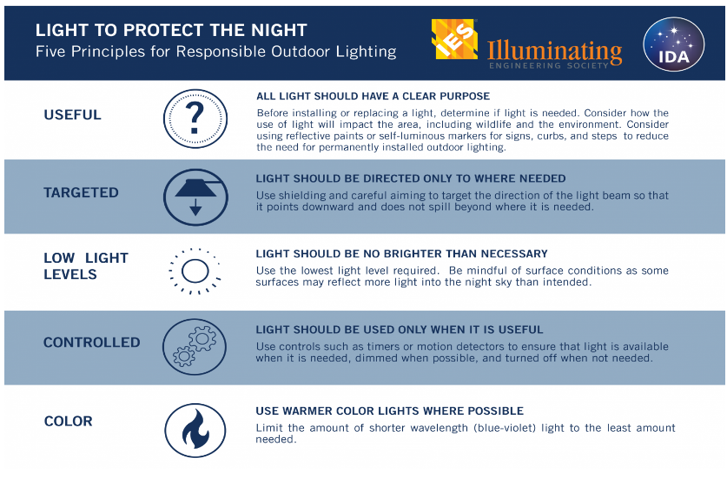
"The first thing I recommend people ask is: 'Is your outdoor lighting necessary?"
Source: IDA
If the answer is yes, there are ways to minimize the impact.
"You can use the lowest brightness necessary (watts), shield your outdoor lighting so the beams are more directed, and use motion sensors or timers ( they are also better for safety)," she suggested.

According to the IDA, "35% of lighting is wasted due to unshielded or poorly aimed fixtures." Wasted energy means wasted money. According to the IDA, $3 billion. Yearly.
It's not just outdoor lighting that should be addressed; Torkildson also recommends pulling curtains to keep indoor lighting from shining outside.
Implementing just a few of these steps can make a significant difference in helping to preserve our dark skies.
"Reducing light pollution helps us reconnect with the night sky and feel the sense of the awe our ancestors [were able to] take for granted. We are losing our common and universal heritage," Torkildson said.
*Watch the award-winning new film from PBS North (with Grand Portage resident Travis Novitsky), “Northern Nights, Starry Skies,” to learn more.
*Check out the book "Spirits Dancing - The Night Sky, Indigenous Knowledge & Cultural Connections to the Cosmos" by Travis Novitsky and Annette S. Lee. Boreal Community Media spoke with Novitsky about the book, which can be read here.

By Laura Durenberger-Grunow - Boreal Community Media - Updated April 17, 2025, Originally posted April 17, 2023
Cook County and Grand Portage residents are well aware of the magical beauty a clear night sky brings. Visitors to the area are often amazed by the vast number of stars and planets visible with the naked eye, and of course, the breathtaking sight of the Milky Way. People travel from all over to get a glimpse, even sparking a newer form of tourism called 'astrotourism'.
The Bortle Scale - Source: IDA tumblr
But that's not the case everywhere, and dark skies are at risk.
Boreal Community Media spoke with Caroline Torkildson, a delegate of the International Dark Sky Association (IDA) and the Minnesota chapter of the IDA, Starry Skies North, to learn more about light pollution at night and ways we can help keep our skies dark.
"Eighty percent of Americans and one-third of humanity can’t see the Milky Way," Torkildson shared.
Organizations like Starry Skies North and the International Dark-Sky Association (IDA) are working to preserve darkness and educate others about the importance of reducing light pollution at night.
In July 2020, the Boundary Waters Canoe Area Wilderness was named a 'Dark Sky Sanctuary by the IDA - one of 13 such places in the entire world. It's also the largest site at 1,098,000 acres, according to the National Forest Service - Superior. Voyageurs National Park was named a "Dark Sky Park" around the same time.
According to the IDA, a Dark Sky Sanctuary is “public or private land that has an exceptional or distinguished quality of starry nights and a nocturnal environment that is protected for its scientific, natural, or educational value, its cultural heritage, and/or public enjoyment.”
Looking beyond astrotourism and public enjoyment, there are also impacts on human health and the ecosystems we live in due to brightening skies.
Here are five things to know about light pollution at night.
More lights do not necessarily equal a safer space
It's common knowledge that the more streetlights and house lights we have turned on in a community, the safer it is. Right?"We may feel safer, but the common bright, bluish, unshielded lights actually decrease safety. These lights cause glare and can be so bright that we can’t see in the shadows," Torkildson said.
It's about quality, not quantity, she continues.
"Better lighting helps with safety. Timers, motion sensors, shielded lights, and warmer bulb temperatures (amber) all contribute to safety by reducing glare, and motion sensors turn on only when something is there, alerting us."
Light bulb color and temperature
Turns out that bulb temperature and color are very important in preserving the dark sky. Even better, it's a simple solution that we can implement in our everyday lives.
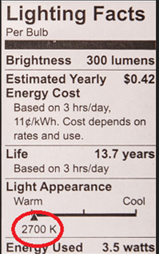
Torkildson recommends replacing the typical blue LED bulbs with warmer-colored options.
All bulbs have a label, either on the packaging or on the bulb itself.
Look for:
- ‘light appearance’ of warm white, 2700 K or lower (K means Kelvin and is a scale of temperature),
- ask for dark sky-approved options
- look for 'wildlife-friendly' lighting
Here is an example of a label:
The harmful effects of blue lights
Excessive lighting at night may not seem like a significant issue, but it poses risks to human health.Most of that comes in the form of blue light emitted from indoor and outdoor lighting.
"One of the main health concerns is that indoor and outdoor blue light more adversely suppresses melatonin (a key ingredient that helps us sleep) at night than warmer bulb colors," Torkildson said.
Melatonin suppression can then affect our circadian rhythms, which can "increase risks for obesity, depression, sleep disorders, diabetes, breast, prostate and colon cancer," she added.
Indoor and outdoor blue lighting has become a significant concern for human health, prompting the American Medical Association to recommend reducing exposure to blue light and adopting good outdoor lighting practices in 2016.
Torkildson shared that "it is estimated blue LEDs have five times more impact on circadian rhythms than the old sodium lights."
And it's not just human beings that are affected. Our ecosystems are also impacted.
Ecosystem impacts
According to research scientist Christopher Kyba via the IDA, "For nocturnal animals, the introduction of artificial light probably represents the most drastic change human beings have made to their environment. Near cities, cloudy skies are now hundreds, or even thousands, of times brighter than they were 200 years ago."Unfortunately, the impacts on the ecosystems we live in and rely on are significant. Many species rely on darkness to survive, and the increase in artificial lighting at night is significantly impacting them. If you'd like to learn more, visit: https://www.darksky.org/light-pollution/wildlife/
Ways we can help
Besides replacing blue light LED bulbs (both indoors and outdoors) with warm-colored ones, Torkildson shared other ways we can take action to reduce light pollution."The first thing I recommend people ask is: 'Is your outdoor lighting necessary?"
Source: IDA
If the answer is yes, there are ways to minimize the impact.
"You can use the lowest brightness necessary (watts), shield your outdoor lighting so the beams are more directed, and use motion sensors or timers ( they are also better for safety)," she suggested.
Theodore Roosevelt National Park via IDA
According to the IDA, "35% of lighting is wasted due to unshielded or poorly aimed fixtures." Wasted energy means wasted money. According to the IDA, $3 billion. Yearly.
It's not just outdoor lighting that should be addressed; Torkildson also recommends pulling curtains to keep indoor lighting from shining outside.
"Reducing light pollution helps us reconnect with the night sky and feel the sense of the awe our ancestors [were able to] take for granted. We are losing our common and universal heritage," Torkildson said.
Ways to get involved
*For more information, check out starryskiesnorth.org or the International Dark Sky Association at darkskies.org.*Watch the award-winning new film from PBS North (with Grand Portage resident Travis Novitsky), “Northern Nights, Starry Skies,” to learn more.
*Check out the book "Spirits Dancing - The Night Sky, Indigenous Knowledge & Cultural Connections to the Cosmos" by Travis Novitsky and Annette S. Lee. Boreal Community Media spoke with Novitsky about the book, which can be read here.
US Dept of Energy via IDA